2. Behavioral Evolution
Stanford7.82M views
Lecture 2 of Robert Sapolsky's Stanford course Human Behavioral Biology: evolutionary approaches to behaviour, kin selection and reciprocal altruism.
785,248 videos · Physics, biology, chemistry, astronomy and the mathematics underneath them.
7.82M views
Lecture 2 of Robert Sapolsky's Stanford course Human Behavioral Biology: evolutionary approaches to behaviour, kin selection and reciprocal altruism.
 8:12
A 8-minute biology video from Professor Dave Explains covering Catabolism of Carbohydrates: Glycolysis, the section of OpenStax Organic Chemistry (McMurry) it is paired with.
 7:47
Intro
A 8-minute biology video from Professor Dave Explains covering Fill in the Blank, the section of OpenStax Microbiology it is paired with.
 6:27
A 6-minute chemistry video from Professor Dave Explains covering Transcription of DNA, the section of OpenStax Organic Chemistry (McMurry) it is paired with.
 5:09
A 5-minute physics worked example from The Glaser Tutoring Company, solving exercise 1.35 of OpenStax College Physics 2e step by step.
 7:17
A 7-minute chemistry video from Professor Dave Explains covering Enzymes and Coenzymes, the section of OpenStax Organic Chemistry (McMurry) it is paired with.

378K views
Nobel laureate Jack Szostak explains how the first cells could have formed: self-assembling fatty-acid membranes and non-enzymatic RNA copying on the early Earth.
 1:32:45
984K views
Stanford Human Behavioral Biology, lecture 7: Behavioural genetics continued: the limits of heritability and gene-environment interaction.
 1:38:35
1.7M views
Stanford Human Behavioral Biology, lecture 6: Behavioural genetics and how twin and adoption studies estimate heritability.
 1:41:06
1.31M views
Stanford Human Behavioral Biology, lecture 9: Ethology, the study of animal behaviour in natural settings, and what it reveals about humans.
 13:17
24.9M views
Uses simulations of hawks and doves to explain evolutionarily stable strategies.
 1:07:12
8.32K views
Viral genomes and genetics, including the Baltimore classification.
 10:00
15.7M views
Simulates populations of creatures to show how natural selection changes traits over generations.
 1:33:35
2.48M views
Stanford Human Behavioral Biology, lecture 4: Molecular genetics: how DNA, genes and mutations produce variation.
 1:14:09
1.08M views
Stanford Human Behavioral Biology, lecture 5: Molecular genetics continued: gene regulation, transposons and evolutionary change.
 1:36:59
3.44M views
Stanford Human Behavioral Biology, lecture 3: Behavioural evolution continued: kin selection, reciprocal altruism and the evolution of cooperation.
 15:44
 7:44
812K views
Explains diatoms: their glass shells, photosynthesis and outsized role in Earth's oxygen and carbon cycles.
 57:16
4.7K views
Briana Pobiner on the role of scavenging and meat-eating in human dietary evolution.
 32:22
2.54M views
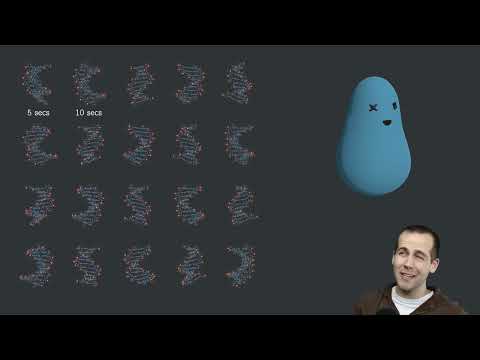
A 30-minute exploration of evolutionary theories of ageing through simulation.
 11:22
Intro6.62M views
Summarises the main lines of evidence for evolution: fossils, anatomy, biogeography and genetics.
 12:15
Intro3.75M views
Explains what atoms are and how scientists discovered them, from Dalton to Rutherford.
 1:05:08
1.24K views
Robin Dunbar on why humans aren't just great apes: social brains and community size.
 1:13:20
64.3K views
Chris Stringer (Natural History Museum) on the origin of our species: the fossil and genetic evidence for Homo sapiens' African origins.

2.96M views
Time-lapse of Harvard's MEGA-plate experiment showing bacteria evolving antibiotic resistance step by step.
 55:27
2.14K views
Kathelijne Koops on chimpanzee tool use and what it suggests about the evolution of human technology.
 57:50
6.69K views
Jeremy DeSilva on how upright walking made us human.
 12:50
2.54M views
Explains what tardigrades really can and can't survive, correcting the 'immortal' myth.
 59:12
3.17K views
Michael Tomasello on the evolutionary origins of human collaboration.
 1:08:20
 20:27
 1:00:46
 47:56
 40:08
 39:53
 56:03