2:02:12

CS50x 2024 - Lecture 3 - Algorithms
CS50Intro460K views
CS50x 2024 lecture 3: algorithms — searching, sorting, running time and recursion.
267,244 videos · Algorithms, systems, security, machine learning and building software.
2:02:12Intro460K views
CS50x 2024 lecture 3: algorithms — searching, sorting, running time and recursion.

Intro629K views
Lecture 1 of MIT 18.404 Theory of Computation by Michael Sipser: finite automata, regular languages and regular expressions.
 2:02:49
Intro582K views
CS50x 2024 lecture 5: data structures — linked lists, trees, hash tables and tries.
 51:57
94.6K views
MIT 6.006, lecture 5: How direct-access arrays, counting sort and radix sort break the n log n comparison barrier.
 57:40
36.9K views
MIT 6.006, lecture 12: Bellman-Ford on graphs with negative weights and how it detects negative cycles via graph duplication.
 57:33
40.7K views
MIT 6.006, lecture 11: Weighted shortest paths, the relaxation framework and DAG shortest paths.
 51:26
256K views
MIT 6.0001, lecture 10: Measuring program efficiency and an introduction to big-O.
 1:03:45
38.4K views
MIT 6.006, lecture 18: Rod cutting, subset sum and what pseudopolynomial running time means.
 52:53
77.1K views
MIT 6.006, lecture 9: Graph representations and breadth-first search for unweighted shortest paths.
 59:09
40.4K views
MIT 6.006, lecture 19: Complexity classes P, NP, EXP, reductions and NP-completeness at an introductory level.
 54:09
101K views
MIT 6.006, lecture 7: AVL balancing: rotations, height augmentation and why balanced trees give O(log n) operations.
 45:39
2.12M views
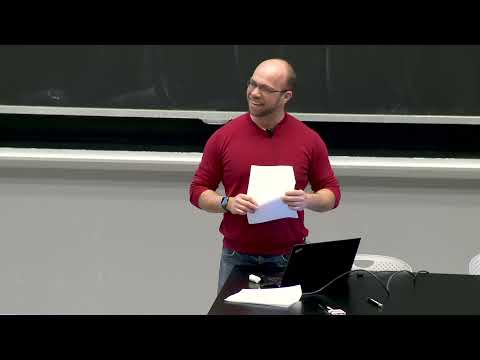
MIT 6.006, lecture 1: The course's model of computation, what correctness and efficiency mean, and asymptotic notation.
 52:23
50.8K views
MIT 6.006, lecture 10: Depth-first search, reachability, topological sort and cycle detection.
 50:59
221K views
MIT 6.006, lecture 6: Binary trees as a sequence and set data structure: traversal order, subtree operations and insertion/deletion.
 57:18
154K views
MIT 6.006, lecture 15: The SRTBOT framework for designing dynamic programs, worked through Fibonacci, DAG paths and the bowling problem.
 49:13
127K views
MIT 6.0001, lecture 11: Common complexity classes from constant to exponential.
 50:18
717K views
MIT 6.006, lecture 2: The difference between interfaces and data structures, linked lists, and how dynamic arrays get amortized constant-time appends.
 52:55
416K views
MIT 6.006, lecture 4: The comparison-model lower bound for search and why hashing beats it, including hash functions, chaining and universal hashing.
 56:53
22.8K views
MIT 6.006, lecture 14: All-pairs shortest paths and Johnson's algorithm's reweighting trick.
 1:03:45
37.2K views
MIT 6.006, lecture 17: DP with expanded subproblems: all-pairs shortest paths via Floyd-Warshall, optimal parenthesization and piano fingering.

2.9M views
Erik Demaine's MIT 6.006 lecture introducing dynamic programming through Fibonacci and shortest paths: memoization, subproblems and guessing.
 48:32
197K views
MIT 6.0001, lecture 12: Search and sorting algorithms, from bisection search to merge sort.
 50:52
78.3K views
MIT 6.006, lecture 8: Priority queues, the array-based binary heap, heapify and in-place heap sort.
 52:56
230K views
MIT 6.006, lecture 3: The set interface, sorted arrays, and selection, insertion and merge sort with recurrence analysis.
 57:22
43.3K views
MIT 6.006, lecture 13: Dijkstra's algorithm, why it needs non-negative weights, and its running time with different priority queues.
 58:44
81.8K views
MIT 6.006, lecture 16: Dynamic programming on subsequences: longest common subsequence, longest increasing subsequence and coin games.

86.6K views
Diego Ongaro's lecture explaining the Raft consensus algorithm: leader election, log replication and safety.

137K views
Matt Kulukundis presents Google's SwissTable, explaining the SIMD-friendly open-addressing design that made it faster than std::unordered_map.

16.8K views
Erik Demaine's MIT 6.851 lecture introducing succinct data structures: rank, select and compact tries.

394K views
The first lecture of Bartosz Milewski's Category Theory for Programmers: why abstraction and composition matter, and what category theory offers programmers.

114K views
Diego Ongaro's lecture on the Paxos consensus algorithm, recorded for the Raft user study.
 24:47
249K views
Dijkstra's algorithm with lazy and eager priority-queue implementations and their complexity.
 15:53
150K views
Floyd–Warshall all-pairs shortest paths, including negative-cycle detection.
 11:42
Advanced
A 12-minute video from Philipp Kindermann: “Optimal Binary Search Trees: Splay Trees (2/6) | Advanced Algorithms - Lecture 10”.
 5:22
A 5-minute video from NPTEL - Indian Institute of Science, Bengaluru: “Lec 157 Implementing binary search”.
 55:45
Advanced
A 56-minute video from Centre de recherches mathématiques - CRM: “Mark Iwen: Mini-course on Sublinear-Time Algorithms for Approximating Functions of Many Variables V”.