
 69videos
3Blue1Brown
8.75M subscribers on YouTube
Shorts, livestreams, trailers and promos are never listed. Unless a curator approved this channel in full, only individually picked videos appear.
Playlists · 15


All 15 playlists
- The block collision puzzle · 3 videos
- Selected lectures on computational thinking for MIT 18.S191 · 3 videos
- Central limit theorem · 3 videos

But what is a neural network? | Deep learning chapter 1
Intro25.1M views
Builds up what a neural network actually is — neurons as numbers, layers, weights and biases — using handwritten-digit recognition as the running example.

But what is the Fourier Transform? A visual introduction.
Intro12.6M views
A visual introduction to the Fourier transform: winding a signal around a circle to find its frequencies.

Linear transformations and matrices | Chapter 3, Essence of linear algebra
Intro7.32M views
Matrices as linear transformations of space — the single idea that makes linear algebra click.

The essence of calculus
Intro11.9M views
The first chapter of Essence of Calculus: discovering derivatives and integrals from the area of a circle.

Bayes theorem, the geometry of changing beliefs
Intro6M views
Bayes' theorem as a geometric picture, with the classic 'Steve the librarian' example.

But what is a Fourier series? From heat flow to drawing with circles | DE4
Intro19M views
Fourier series from the heat equation to drawing pictures with rotating circles.
 22:11
But what is the Riemann zeta function? Visualizing analytic continuation
Intro5.39M views
Visualises the Riemann zeta function as a transformation of the complex plane and explains what analytic continuation actually means.

Gradient descent, how neural networks learn | Deep Learning Chapter 2
Intro9.73M views
How a network 'learns': cost functions, the gradient, and stepping downhill in a space with thousands of dimensions.
 11:15
The hardest problem on the hardest test
16.4M views
Works through the famously hard Putnam problem about the probability that a random tetrahedron in a sphere contains its centre, by first solving the 2D version.

Transformers, the tech behind LLMs | Deep Learning Chapter 5
Intro11.6M views
How transformer models (the 'T' in GPT) turn text into vectors and predict the next token, step by step.
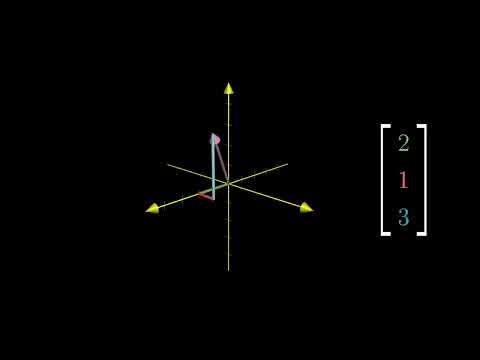
Vectors | Chapter 1, Essence of linear algebra
Intro13M views
What a vector really is, from the physics, computer science and mathematics perspectives.

Attention in transformers, step-by-step | Deep Learning Chapter 6
Intro4.88M views
The attention mechanism in detail: queries, keys, values and how context flows between words.

Backpropagation, intuitively | Deep Learning Chapter 3
Intro6.39M views
An intuitive walkthrough of backpropagation — how each training example nudges every weight and bias.

But what are Hamming codes? The origin of error correction
Intro3.05M views
Hamming codes and the origin of error correction: how data can fix its own errors.
 28:34
But why would light "slow down"? | Visualizing Feynman's lecture on the refractive index
Intro2.89M views
Explains why light appears to slow down in glass and where the index of refraction comes from, building from driven oscillating charges.

Eigenvectors and eigenvalues | Chapter 14, Essence of linear algebra
Intro6.45M views
Eigenvectors and eigenvalues, seen as the directions a transformation only stretches.
 9:59
Linear combinations, span, and basis vectors | Chapter 2, Essence of linear algebra
7.62M views
Linear combinations, span and basis vectors, chapter 2 of Essence of Linear Algebra.
 10:04
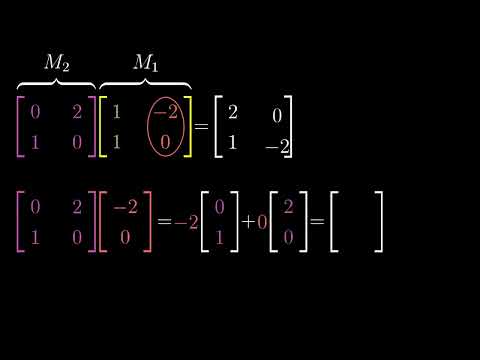
Matrix multiplication as composition | Chapter 4, Essence of linear algebra
4.5M views
Matrix multiplication as composition of linear transformations, chapter 4 of Essence of Linear Algebra.

The determinant | Chapter 6, Essence of linear algebra
Intro5.02M views
The determinant as the factor by which a transformation scales area and volume.
 21:14
The medical test paradox, and redesigning Bayes' rule
Intro1.43M views
Uses the 'medical test paradox' to motivate rewriting Bayes' rule in terms of odds and Bayes factors.
 34:41
But what is a Laplace Transform?
2.13M views
Builds the Laplace transform from exponentials and the s-plane, showing what poles mean and how it turns differential equations into algebra.
 23:01
But what is a convolution?
3.8M views
Convolution seen three ways: moving averages, polynomial multiplication and probability, ending with FFT-based fast convolution.
 31:15
But what is the Central Limit Theorem?
4.61M views
What the central limit theorem actually says, its assumptions, and why sums of random variables tend to a bell curve.
 28:33
Terence Tao on the cosmic distance ladder
6.52M views
Terence Tao and Grant Sanderson walk through how humans measured the size of the Earth, Moon, Sun and the distances to stars and galaxies, rung by rung.
 22:21
Why do prime numbers make these spirals? | Dirichlet’s theorem and pi approximations
Intro7.64M views
Starts from a curious spiral pattern in plots of primes and uses it to explain residue classes, Euler's totient and Dirichlet's theorem on primes in arithmetic progressions.

Divergence and curl: The language of Maxwell's equations, fluid flow, and more
Intro5.34M views
Divergence and curl as properties of flows — the language behind Maxwell's equations and fluid dynamics.
 21:36
Fractals are typically not self-similar
Intro4.56M views
Explains fractal dimension and why most fractals are not perfectly self-similar, with coastlines and the Sierpinski triangle as examples.

The more general uncertainty principle, regarding Fourier transforms
Intro2.35M views
Why the uncertainty principle is really a general fact about Fourier transforms — from Doppler radar to quantum mechanics.
 31:51
Visualizing the 4d numbers Quaternions
Intro5.6M views
Builds intuition for quaternions by stereographic projection, working up from complex numbers to 4D rotations.

But how does bitcoin actually work?
Intro18.1M views
How a cryptocurrency ledger actually works: signatures, hashing and proof of work, built up from a shared ledger.

Euler's formula with introductory group theory
Intro2.75M views
Euler's formula e^(iπ) = −1 explained through introductory group theory.

Why π is in the normal distribution (beyond integral tricks)
Intro2.22M views
Why π shows up in the normal distribution, explained through the Herschel–Maxwell derivation.
 13:16
A pretty reason why Gaussian + Gaussian = Gaussian
968K views
A 13-minute video from 3Blue1Brown's catalogue; the title names its topic.
 13:13
A quick trick for computing eigenvalues | Chapter 15, Essence of linear algebra
1.37M views
A 13-minute video from 3Blue1Brown's catalogue; the title names its topic.
 40:06
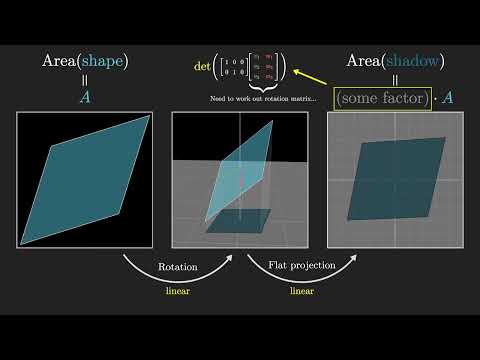
A tale of two problem solvers | Average cube shadow area
3.55M views
A 40-minute video from 3Blue1Brown's catalogue; the title names its topic.
 16:46
Abstract vector spaces | Chapter 16, Essence of linear algebra
1.83M views
A 17-minute video from 3Blue1Brown's catalogue; the title names its topic.