
 2:16:20
Basic Parameter Estimation, Reverse-Mode AD, and Inverse Problems
A 136-minute video from Parallel Computing and Scientific Machine Learning: “Basic Parameter Estimation, Reverse-Mode AD, and Inverse Problems”.
5.95K subscribers on YouTube
Shorts, livestreams, trailers and promos are never listed. Unless a curator approved this channel in full, only individually picked videos appear.
2:16:20A 136-minute video from Parallel Computing and Scientific Machine Learning: “Basic Parameter Estimation, Reverse-Mode AD, and Inverse Problems”.
 1:15:44
A 76-minute video from Parallel Computing and Scientific Machine Learning: “Code Profiling and Optimization (in Julia)”.
 47:58
A 48-minute video from Parallel Computing and Scientific Machine Learning: “Differentiable Programming Part 1: Reverse-Mode AD Implementation”.
 1:36:11
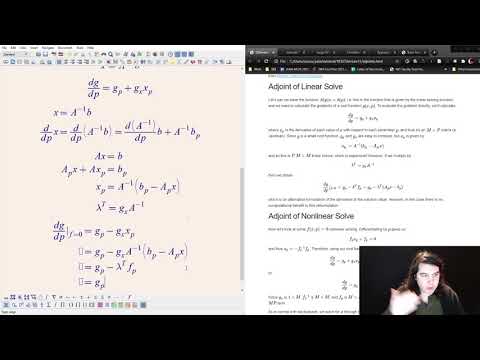
A 96-minute video from Parallel Computing and Scientific Machine Learning: “Differentiable Programming Part 2: Adjoint Derivation for (Neural) ODEs and Nonlinear Solve”.
 1:51:05
A 111-minute video from Parallel Computing and Scientific Machine Learning: “Forward-Mode Automatic Differentiation (AD) via High Dimensional Algebras”.
 1:46:50
A 107-minute video from Parallel Computing and Scientific Machine Learning: “From Optimization to Probabilistic Programming”.
 33:43
A 34-minute video from Parallel Computing and Scientific Machine Learning: “GPU Programming in Julia”.
 34:11
A 34-minute video from Parallel Computing and Scientific Machine Learning: “Getting Started with Julia (for Experienced Programmers)”.
 1:19:43
A 80-minute video from Parallel Computing and Scientific Machine Learning: “Global Sensitivity Analysis”.
 1:03:51
A 64-minute video from Parallel Computing and Scientific Machine Learning: “How Loops Work 1: An Introduction to the Theory of Discrete Dynamical Systems”.
 48:37
A 49-minute video from Parallel Computing and Scientific Machine Learning: “How Loops Work 2: Computationally-Efficient Discrete Dynamics”.
 28:22
A 28-minute video from Parallel Computing and Scientific Machine Learning: “Introduction to Scientific Machine Learning 1: Deep Learning as Function Approximation”.
 29:00
A 29-minute video from Parallel Computing and Scientific Machine Learning: “Introduction to Scientific Machine Learning 2: Physics-Informed Neural Networks”.
 58:59
A 59-minute video from Parallel Computing and Scientific Machine Learning: “Mixing Differential Equations and Neural Networks for Physics-Informed Learning”.
 1:20:57
A 81-minute video from Parallel Computing and Scientific Machine Learning: “Optimizing Serial Code in Julia 1: Memory Models, Mutation, and Vectorization”.
 1:25:00
A 85-minute video from Parallel Computing and Scientific Machine Learning: “Optimizing Serial Code in Julia 2: Type inference, function specialization, and dispatch”.
 39:50
A 40-minute video from Parallel Computing and Scientific Machine Learning: “Ordinary Differential Equations 1: Applications and Solution Characteristics”.
 1:31:35
A 92-minute video from Parallel Computing and Scientific Machine Learning: “Ordinary Differential Equations 2: Discretizations and Stability”.
 43:00
A 43-minute video from Parallel Computing and Scientific Machine Learning: “Parallel Computing and Scientific Machine Learning Course: Syllabus”.
 28:09
A 28-minute video from Parallel Computing and Scientific Machine Learning: “Parallel Computing: From SIMD to SIMT”.
 1:38:29
A 98-minute video from Parallel Computing and Scientific Machine Learning: “Partial Differential Equations (PDEs), Convolutions, and the Mathematics of Locality”.
 2:21:02
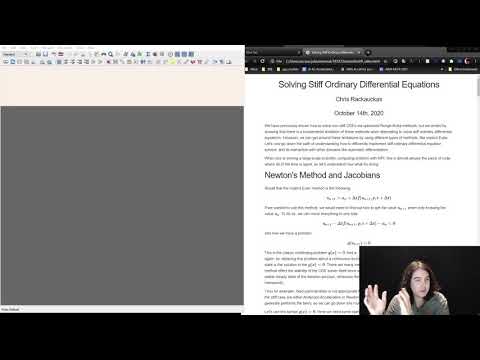
A 141-minute video from Parallel Computing and Scientific Machine Learning: “Solving Stiff Ordinary Differential Equations”.
 1:32:54
A 93-minute video from Parallel Computing and Scientific Machine Learning: “The Basics of Single Node Parallel Computing”.
 1:51:30
A 112-minute video from Parallel Computing and Scientific Machine Learning: “The Different Flavors of Parallelism: Parallel Programming Models”.
 47:16
A 47-minute video from Parallel Computing and Scientific Machine Learning: “Uncertainty Programming: Differentiable Programming Extended to Uncertainty Quantification”.